
Pool Filter Repair: A Technician's Guide to What's Actually Wrong
High pressure, cloudy water, or a puddle under the equipment pad? Here's how we narrow down a filter problem, what's genuinely homeowner-level, and why the tank itself is the part to leave alone.
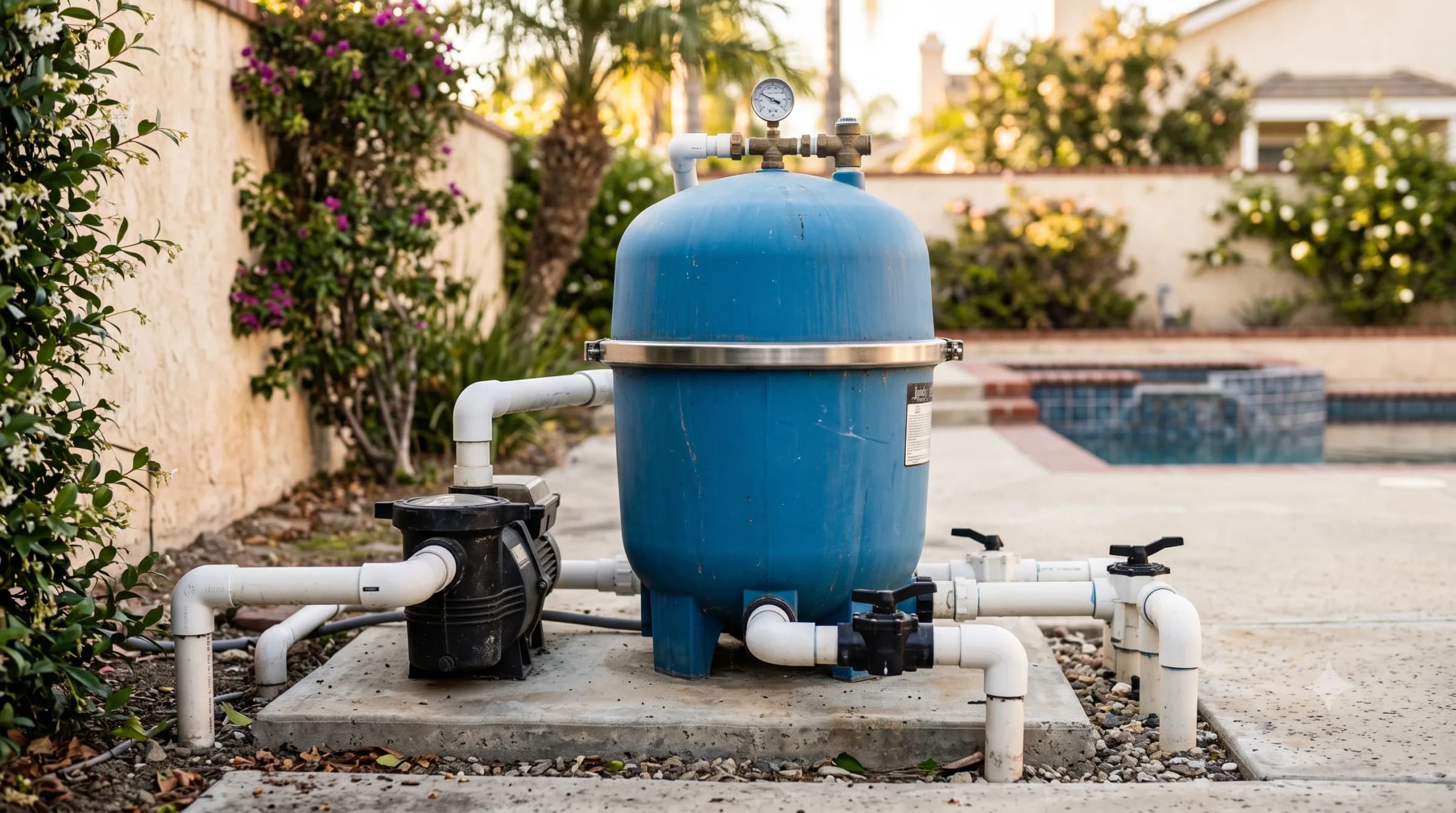
Most pool filter repair starts with the same moment: the pressure gauge is reading high, the water's gone cloudy, or there's a puddle spreading under the equipment pad. Some of what goes wrong is a routine part swap. Some of it involves opening a pressure vessel, which is a different category of job with real injury risk if it's done wrong. This guide walks through how we narrow down a filter problem before quoting a fix, so you can tell which one you're looking at. We're a family-owned pool service in Agoura Hills, California licensed contractor #1089430.
Start here: match your symptom to the likely cause
Use this to narrow things down, not to reach a final diagnosis. Filters share symptoms with pumps, valves, heaters, and plain water chemistry, so more than one of these can be true at once.
| What you're seeing | Common causes worth checking first | DIY or pro? |
|---|---|---|
| Gauge reads well above your clean baseline | Dirty cartridge or grids. Also check for a closed return valve, a heater valve fault, or a failed gauge | Usually a cleaning |
| Cloudy water | Chemistry, sanitizer, run time, or bather load far more often than the filter. If chemistry is genuinely balanced, then look at torn media | Chemistry first, pro if unresolved |
| Debris blowing back into the pool | Torn cartridge or DE grid, a failed internal o-ring, a cracked manifold or standpipe, or an assembly error | Pro diagnosis |
| Water weeping from the tank clamp or band | Damaged or dirty o-ring, a misseated or loose clamp, or a cracked tank | Shut the pump off and call |
| Leak at the multiport valve or during backwash | Worn spider gasket or valve seal | Often pro |
| A visible crack or split in the tank body | Age, UV, freeze, chemical damage, trapped air, or prior impact | Pro. Stop running it |
| DE powder returning to the pool | Torn grid, cracked manifold, or incorrect reassembly | Pro |
| Pump won't hold prime, pressure won't build | Usually a suction-side air leak, not the filter at all | Pro diagnosis |
Your “clean baseline” is what the gauge reads right after a cleaning, so write that number on the tank with a marker. Manufacturers set their own threshold for when a rise above that baseline means it's time to clean, and the figure differs by model, so check your filter's manual rather than trusting a number from a blog. One thing that catches people out: if you run a variable-speed pump, the comparison only means anything at the same RPM, because pressure moves with speed.
Cartridge, DE, or sand? Repairs differ by filter type
What's inside the tank shapes both the failure modes and the work involved.
- Cartridge filters are the most common on Conejo Valley residential pools. Water passes through a pleated fabric element. Typical service is rinsing or replacing the cartridge, a tank band o-ring, or a pressure gauge.
- DE (diatomaceous earth) filtersuse a fine white powder, the “DE,” coating a set of internal grids. They filter the finest particles, but grids tear and the internal manifold can crack with age, and reassembly has to be exact.
- Sand filters are mechanically simple but hide their failures. A cracked lateral or standpipe sends sand back into the pool, which means opening and emptying the tank.
Cost tracks the specific job far more than the category, so a cheap fix on a DE filter and an expensive one on a cartridge system are both entirely normal.
The filter problems we see most often
These are the failures that come up repeatedly on Conejo Valley service routes.
- Pressure that climbs and stays high.A cartridge loaded with oak pollen, eucalyptus debris, and hard-water calcium restricts flow. Cleaning usually resolves it. If pressure returns quickly afterward, that points to a range of things worth checking: algae or plaster dust in the water, scale on the media, chemistry that's out of balance, an undersized filter, too much pump flow, or a restriction downstream. It isn't automatically a worn-out element.
- A cracked or split housing.The tank holds pressure, and pressure vessels fail for several reasons: years of UV exposure, freeze damage, chemical attack, a clamp that was damaged or installed wrong, trapped air on startup, or an impact. Running at high pressure contributes, but it isn't the only path there. Whatever the cause, a cracked tank gets replaced rather than patched.
- Worn o-rings and gaskets. The band o-ring sealing the two halves of the tank, and the lid o-ring, dry out and flatten in our sun and heat. This is a frequent cause of a seam weep, though not the only one, which is why a weep gets inspected rather than assumed.
- Torn cartridges or DE grids.Once media tears, unfiltered water and DE powder pass back into the pool. You'll often see a white cloud on the return with DE.
- Valve leaks.On DE and sand systems, the multiport valve's internal spider gasket wears and the filter leaks or sends water to waste during normal filtering. Sometimes a gasket, sometimes the valve.
Why we don't publish a step-by-step teardown
Plenty of sites will hand you a generic five-step guide to opening a pool filter. We deliberately won't, and it's worth explaining why.
A pool filter is a pressure vessel. Air trapped inside a tank stores a surprising amount of energy, and a lid or clamp band released while the tank still holds pressure can be thrown hard enough to cause serious injury. That much is universal. Almost nothing else about the procedure is.
The details that keep you safe are specific to your equipment. Whether you need to close isolation valves before draining depends on whether your pad sits below the water line, and getting that wrong floods the equipment area. The clamp band release and torque sequence differs between manufacturers and between models from the same manufacturer. The pressure rise that signals that cleaning is due varies by model, which is why we point to your manual rather than quote a single number. Priming and restart steps differ too, along with the conditions that mean you should shut down immediately, such as the gauge registering pressure before water flows, or water appearing between the tank halves.
A generic article cannot cover all of that, and a partial procedure is more dangerous than none, because it reads as complete. Your filter's own manual is the authoritative source. Most manufacturers publish them free as PDFs, and yours will have the model-specific torque values, valve positions, and stop conditions that a blog post cannot.
What we'd say plainly:
- Read your model's manual before you open anything, and follow it rather than a general guide.
- Never loosen or tighten a clamp band on a pressurized tank, and never open one until the gauge reads zero. If the gauge doesn't fall to zero, treat the gauge itself as suspect and call someone.
- A cracked tank is not a repair.Epoxies and tank sealants hold until they don't. We replace cracked housings rather than seal them, and the system shouldn't run in the meantime.
- If reassembly ends with “I think that's seated right,” stop. That's the moment a job stops being maintenance. When it crosses into pressure or plumbing work, our licensed pool equipment repair crew takes it from there.
None of that means you can't own your pool's maintenance. It means the tank specifically is the part where the cost of a mistake is measured in injuries rather than dollars.
Repair or replace? How we think about it
Almost anything can be repaired. The real question is whether it should be, and that's a judgement call rather than a formula. A cracked tank gets replaced at any age. Beyond that:
- Newer tanks in sound condition are usually worth repairing. O-rings, gauges, and cartridges are ordinary wear items.
- Mid-life tanks are worth pricing both ways when the repair involves internal grids or a manifold, especially if the housing shows sun-brittleness or crazing.
- Older tanksdeserve a closer look at the housing itself before you invest in internals, because a grid set can cost a meaningful fraction of a new filter. Age alone doesn't condemn a tank, but UV exposure and heat do accumulate here.
A general rule we use: when a repair approaches half the installed cost of replacement, price both and decide with the numbers side by side. A filter that keeps failing may also be undersized for the pool, which is worth correcting once rather than repairing repeatedly.
What drives the cost of pool filter repair
We quote filter work at the diagnosis visit rather than over the phone, because the same symptom can be a short gasket swap or a full teardown. The factors that actually move the number:
- Filter type and size, and how much media or how many internal parts are involved.
- Which part failed. An o-ring, gauge, or single cartridge sits at the low end. A full grid set, a multiport valve, or the tank itself sits at the high end.
- Whether the tank has to be opened, drained, and re-pressurized, which is where the labor and the care go.
- Part availability. Common Hayward, Pentair, and Jandy parts are typically quick to source. Older or discontinued models can mean a lead time.
- Whether repair still makes sense. On an aging tank, ask for the replacement number alongside the repair number so you can weigh them together.
Filter problems also tend to surface earlier when someone is looking at the equipment weekly, which is one of the practical benefits of ongoing weekly pool maintenance.
Getting it looked at
Twenty-plus years of pool service, family-owned, California licensed contractor #1089430. If your filter is leaking, returning debris, or reading high, we serve Westlake Village, Agoura Hills, and offer trusted pool service in Thousand Oaks and across the Conejo Valley. Call us at (805) 200-8360 for a free, no-obligation quote.
Frequently Asked Questions
Keep Reading
All Articles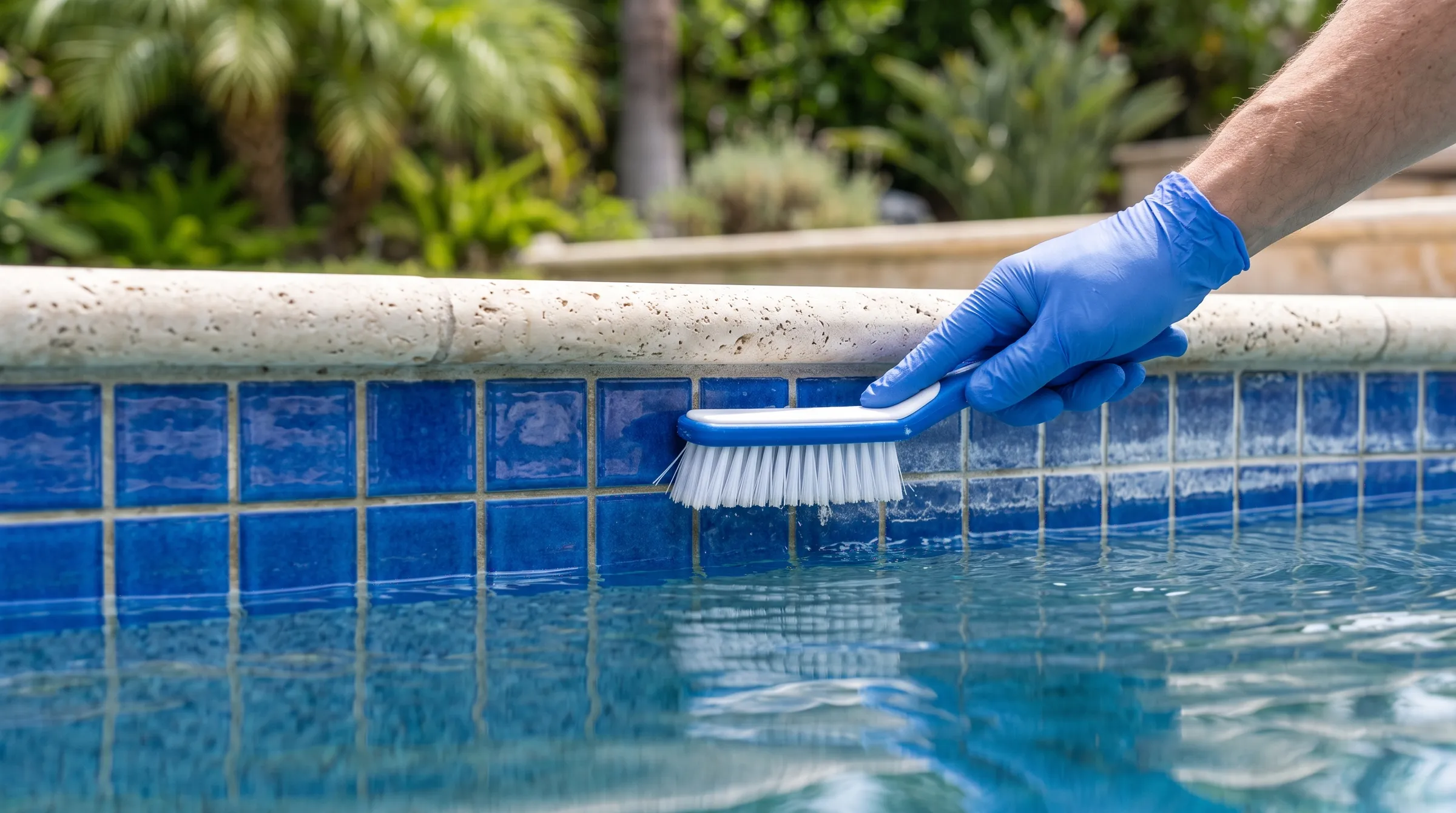
How to Clean Pool Tile (and When to Stop DIY-ing It)
Most waterline tile only needs a weekly brush and the right cleaner. Here's how to match the method to your tile and what's on it, which tools cause damage, and when calcium needs bead blasting.
Read Article
Pool Is Cloudy but Chemicals Are Fine? Here's What's Actually Going On
Your test kit says the water is balanced, but the pool is still hazy. Here are the four real causes, from high CYA to a tired filter, and how to tell which one you have.
Read ArticleReady for a Cleaner Pool?
Clear Conceptz handles the maintenance, repairs, and restoration so you can just enjoy the water. Contact us today for a free estimate.